Game Lobby
Everything starts on the Games page.
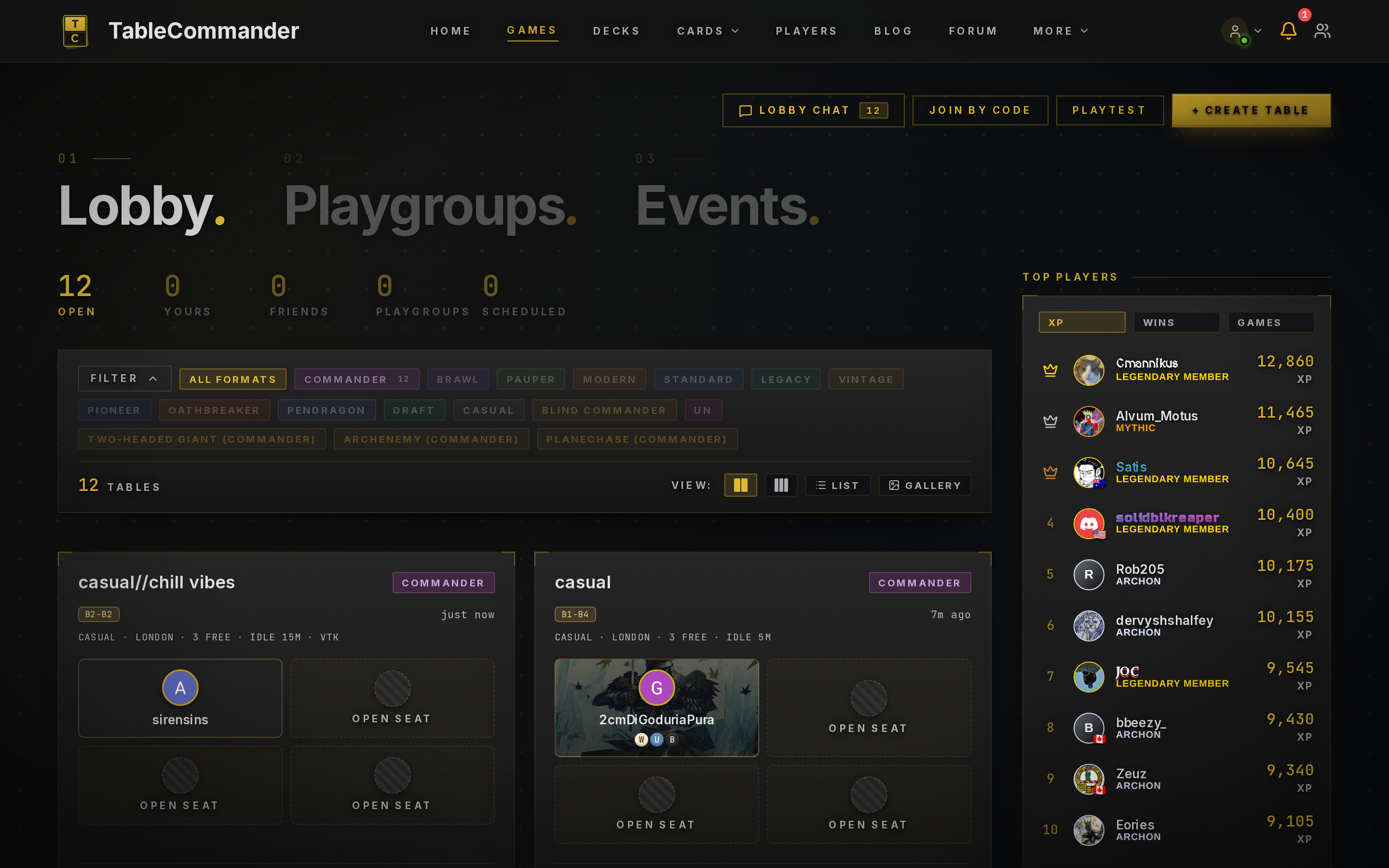
Finding a game#
The top of the page has five slices: Open, Your Tables, Friends, Playgroups and Scheduled. Open is every public table waiting for players. Friends and Playgroups are tables your friends or groups have put up. Scheduled is tables with a start time in the future.
Filter by format with the pills under the heading. Each card shows the table name, format, game mode, mulligan rule and idle timeout, plus who's sitting where. Commander tables also show the bracket range the host is after.
To sit down, click an Open Seat. If a game is already under way you'll see Spectate instead, which drops you in as a viewer. There's no host toggle for that. Anyone can watch a public game.
Two more things up top. Lobby Chat is a room for everyone on the page, handy for "anyone up for a 4 pod?". Playtest starts a solo game with two of your own decks, which is the fastest way to learn the controls before you sit down with people.
Joining by code#
Every table has a six character invite code. Click Join by Code, type it in, and you're at the table. This is the only way into Private tables, and the quick way into any table when a friend has sent you the code.
Hosting#
Click + Create Table. The options are covered in Your First Game. The short version: pick a format, decide who can see it, and leave the rest on defaults until you have an opinion.
The pregame lobby#
Once a table exists you're in the lobby. Each seat shows who's in it and whether they've picked a deck. Chat is open, so this is where house rules get agreed.
- Players click Pick a Deck, choose from their library, then Ready Up.
- The host's Start button goes live once at least two players are seated and everyone is ready.
- Empty seats have an Invite button that sends a notification to a friend, and Move Here if you'd rather sit somewhere else.
- The host can Kick someone from a seat and Shuffle seats to randomise turn order. In team formats that button becomes Random teams.
- If the host wanders off, another seated player can claim host and start the game.
Lobbies that never fill close themselves after a while, so nothing hangs about in the list forever.
When someone drops#
Connections fail. The game is built around that.
Reconnecting. If a player loses connection, their seat shows a five minute countdown. Their turns are passed automatically while they're gone. If they come back inside the window, they carry on as if nothing happened.
After the grace period. Their badge changes to "Disconnected (Auto-passing)" and the other players can vote to remove them. The game continues without them.
Idle players. Separately from disconnects, every table has an idle timeout (15 minutes by default, set when the table is created). Someone who hasn't acted in that long gets flagged and can be removed the same way.
Vote to kick#
Tables can also be created with Vote to Kick on. This is for the rare case of someone who is connected and taking turns but ruining the game. It's deliberately hard to abuse:
- Any player can call a vote on any other player.
- Every other player still in the game has to agree. One no and it fails.
- It needs at least three players still alive, the vote lasts 90 seconds, and there's a ten minute cooldown between votes.
- Every vote, pass or fail, is logged and visible to staff.
To call one, open the feedback button in the game sidebar (the speech bubble with a warning mark), choose the Report tab, pick the player, give a reason, and press Call a vote. It only appears on tables with the setting on and three or more players still alive.
It's off by default. If you're playing with strangers and want a safety valve, turn it on when you create the table.
Next steps#
- The playmat, what's on screen once the game starts
- Game controls, moving cards and using the sidebar